← Back
4 Bases
24 Automations
$257M+ GMV
9M+ Units
103K+ Items
When I joined Ghost, inventory tracking lived in a Google Sheet called "Sales Tracker." By
the time I was done, I'd built 4 Airtable bases running 24 automations, connected to
Slack, n8n, TableFlow, and Ghost's internal API. One person, end to end.
The Evolution
01 Google Sheets
2022
Started as a spreadsheet called "Sales Tracker." Every deal tracked manually, data
scattered across tabs.
02 Asana
2023
Moved to Asana for project management. Better than Sheets, but inventory tracking
outgrew it fast.
03 Asana + Offshore
2023
Scaled the team with BPO contractors. More hands, but the tools weren't built for
the volume.
04 Airtable
2024 → Present
Built the whole system from scratch. Linked bases, automations that run themselves,
dashboards that update live. This is the version that stuck.
Base 01 Inventory Upload
The core base. Takes messy seller inventory data — spreadsheets, emails, whatever they
send — and turns it into clean records ready to list.
0Total
0Pending
0Listed
0Sold
Nike42GoldListed
Adidas28SilverPending
New Balance18BronzeListed
Puma12BronzeSold
Architecture
Linked records, rollups, and AI-generated fields. Every stage of the pipeline is
visible without anyone asking for an update.
Daily Users
Account Managers, Brand Partners, and offshore contractors — all looking at the same
data.
Interfaces
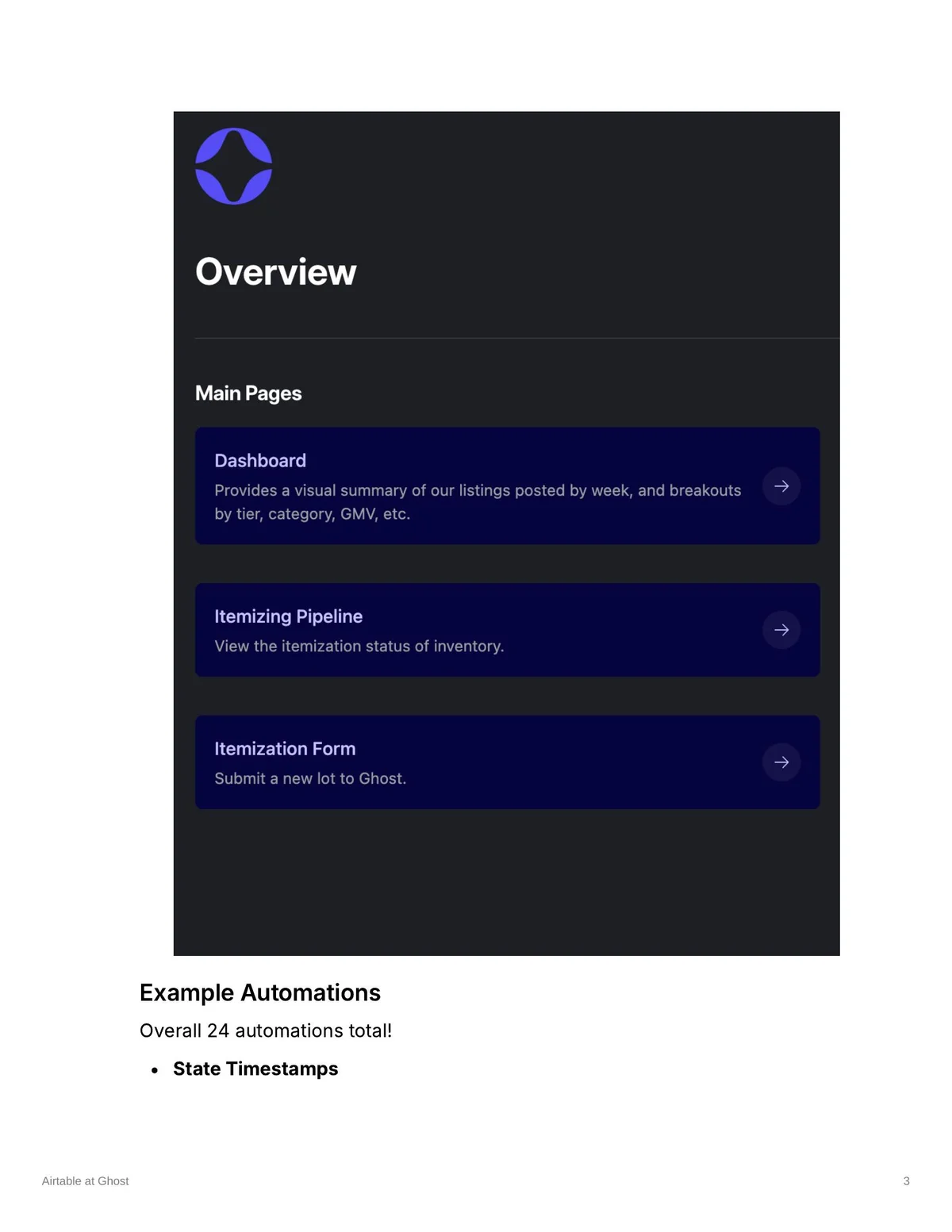
Dashboard for weekly listing summaries. Itemizing Pipeline for status tracking.
Submission form for new lots.
Tables
Product & Inventory tables track each item from intake to sale. Entity tables for
people and orgs. Workflow tables for ops and exceptions.
Base 02 Deal Approvals
Our director of finance had deal approvals spread across email and Asana. I pulled admin
data into Airtable, synced it with the metrics she actually cared about, and gave her one
place to review and approve everything.
Added an n8n workflow so she can approve or reject deals by reacting to the Slack
notification with an emoji. The automation pulls deal data, formats the financials, looks
up the right admin and account manager, and posts a complete summary. Updates get threaded
to the original message by storing the Slack timestamp back in Airtable.
Base 03 Enterprise Offers
Standardizes how we build linesheets for enterprise buyers like Costco, Sam's Club, and
BJ's. My team gathers market data and the system formats it into whatever template each
buyer needs.
Every retailer wants offers in a different format. The system pulls from inventory data,
Shopify listings, and internal databases to match what we have to what the buyer wants.
Base 04 International Quotes
International deals have different logistics, compliance, and pricing. I gave them their
own base so they wouldn't clutter the domestic pipeline.
Under the Hood
The automations run everything. Timestamps, webhook triggers, Slack notifications, data
ingestion. All running without anyone touching them.
State Timestamps
Date fields auto-update between stages. Shows processing speed without manual input.
Webhook Triggers
Button-triggered scripts call n8n to write listing descriptions from seller inventory
files.
TableFlow Ingestion
TableFlow parses and cleans seller spreadsheets, matches them against existing
records, and imports them.
Record Sync
Linked records sync across all 4 bases automatically. No manual reconciliation.
Slack Alerts
Slack alerts on stage changes, new submissions, and deal updates. Threaded to the
right channel.